
How to Choose Primers for Firearms the Right Way (Before You Waste Ammo)
After years of working directly with firearm owners, reloaders, and competitive shooters, one pattern shows up again and again: most primer problems are discovered after ammo has already been wasted.
That’s not theory. That’s observation.
At American-Primers, we regularly hear from shooters who did everything “right” — quality firearm, reputable components, careful assembly — yet still experienced inconsistent ignition, unexplained accuracy issues, or reliability concerns. In most of those cases, primer selection was either misunderstood or treated as an afterthought.
This article is written from the perspective of a primers-focused supplier who sees real purchasing behavior, repeat customer feedback, and long-term usage patterns, not just isolated range results. If you want to understand how to choose primers for firearms properly — and avoid wasting ammo in the process — this guide is built for you.
Why Primer Choice Is Where Most Shooters Go Wrong
One of the most common assumptions we hear is, “A primer is a primer — if it fits, it works.”
In practice, that assumption costs shooters more time and ammunition than almost any other component decision.
We’ve seen customers change barrels, optics, and even firearms chasing problems that were ultimately traced back to inconsistent or mismatched primers. Once the primer variable was corrected, performance stabilized — often immediately.
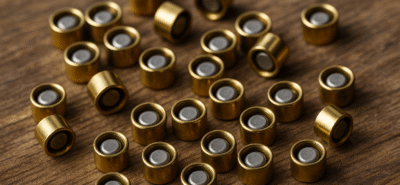
Primers may be small, but they control the first and most influential event in the firing sequence. When ignition is inconsistent, every variable downstream becomes harder to manage. This is why primer selection for firearms should be a deliberate decision, not a convenience choice.
What a Primer Actually Does in a Firearm
A primer initiates ignition, but its influence extends far beyond simply “starting the shot.”
From a functional standpoint, primers affect:
- ignition reliability
- pressure development
- velocity consistency
- shot-to-shot repeatability
Even minor variations in ignition energy or consistency can show measurable differences in performance, particularly over extended shooting sessions or at distance. Check the industry standards for ammunition components.
Experienced shooters don’t evaluate primers by asking whether they function once. They evaluate whether a primer behaves the same way every time, under consistent conditions. That mindset is central to understanding how to choose primers for firearms the right way.
The Main Types of Primers You’ll Encounter
Understanding primer categories doesn’t require deep technical knowledge — but ignoring these distinctions causes most primer-related problems we encounter.
Small Rifle vs Large Rifle Primers
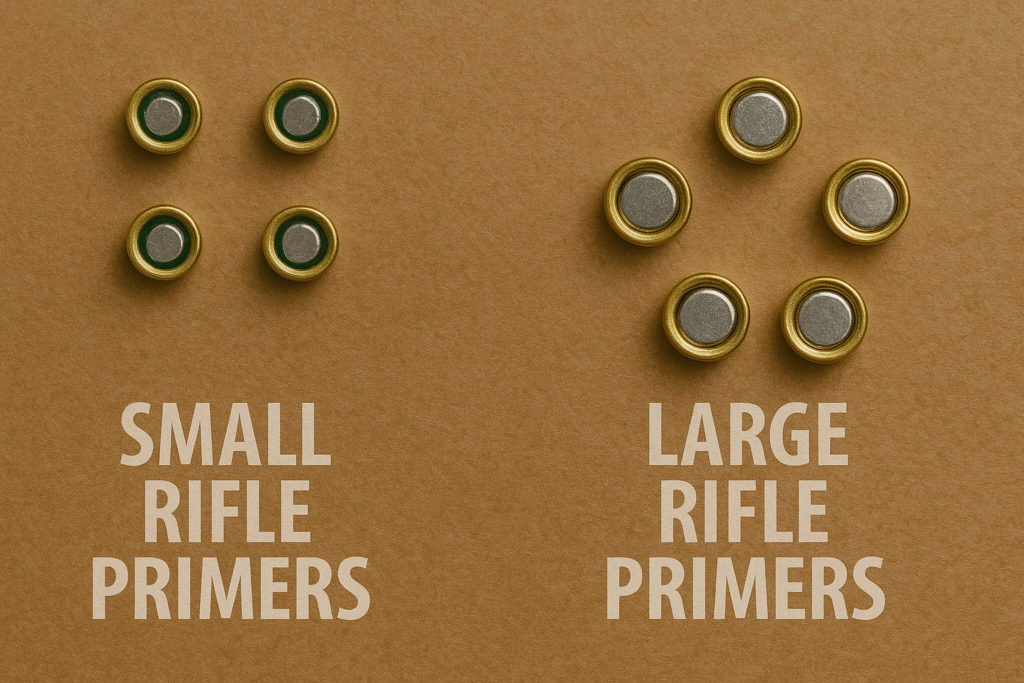
Small rifle and large rifle primers are not interchangeable. They differ in physical dimensions and are designed for different cartridge architectures and pressure environments.
Using the wrong size primer often leads to unreliable ignition, inconsistent performance, or component waste. For shooters asking about the best primers for firearms, size compatibility is always the first factor we verify.
Small Pistol vs Large Pistol Primers
The same principle applies to pistol primers. Size exists for functional reasons, not convenience.
Many shooters waste ammo by assuming minor dimensional differences don’t matter. In real-world usage, they do.
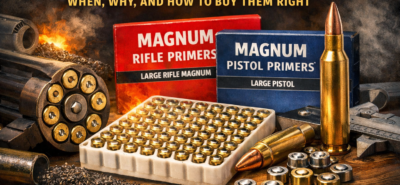
Standard vs Magnum Primers
Magnum primers are frequently misunderstood. They are designed for specific ignition requirements — not as universal performance upgrades.
Inappropriate use of magnum primers can introduce unnecessary pressure variation or inconsistency. Knowing when not to use them is a key part of choosing primers for firearms responsibly.
How to Choose Primers for Firearms Based on Your Use Case
There is no universal “best primer.” There is only the best primer for how a firearm is actually being used.
Choosing Primers for Precision and Accuracy
Shooters focused on accuracy prioritize consistency above all else.
Those evaluating choosing primers for accuracy tend to look for:
- uniform ignition behavior
- stable velocity output
- predictable results across sessions
In our experience, these shooters rarely change primers casually. When they do, they evaluate results carefully and methodically.
Choosing Primers for Reliability and General Shooting
For general shooting, reliability and compatibility often outweigh extreme consistency.
However, choosing the correct primer still prevents misfires, inconsistent ignition, and unnecessary troubleshooting. Reliability-focused shooters benefit just as much from proper primer selection as precision shooters — they just measure success differently.
Choosing Primers for High-Volume Shooting
High-volume shooters face a different challenge: maintaining consistency over time.
Frequent primer changes introduce variables that complicate expectations. This is why shooters who consume large quantities of ammunition often prioritize stable supply and long-term consistency when deciding how to choose primers for firearms.

Match Primers vs Standard Primers: A Practical Perspective
This topic generates more confusion than almost any other primer discussion.
When Match Primers Make Sense
Match primers are produced with tighter manufacturing tolerances. In certain firearms and applications, that additional consistency can be meaningful — particularly for shooters operating near performance limits.
Shooters researching best primers for firearms often assume match automatically equals better. Sometimes it does. Sometimes it doesn’t.
When Standard Primers Are the Better Choice
In many firearms, standard primers perform just as consistently as match primers.
Experienced shooters evaluate results, not labels. They select the primer that produces the most stable outcomes in their specific platform — a practice rooted in evidence, not marketing.
Common Primer Selection Mistakes That Waste Ammo
Across thousands of customer interactions, a few mistakes appear repeatedly.
Choosing Primers Based on Brand Alone
Brand reputation matters, but compatibility matters more. A well-regarded primer is not universally optimal.
Changing Primer Types Without Re-Evaluating Performance
Switching primers introduces a new variable. Shooters who ignore this often misdiagnose resulting issues.
Assuming One Primer Works for Every Firearm
Firearms differ in ignition characteristics. Primer choice should reflect those differences.
These errors explain why so many shooters search for how to choose primers for firearms after experiencing frustration rather than before.
How Experienced Shooters Evaluate Primers
Experienced shooters rely on consistency, repeatability, and documented outcomes.
They:
- observe performance over time
- limit unnecessary variable changes
- focus on predictable ignition behavior
This disciplined approach minimizes wasted ammo and builds confidence in component selection. Look for internal ballistics and ignition consistency.
Why Sourcing and Handling Matter
Primer quality isn’t defined solely by manufacturing. Storage conditions, handling practices, and authenticity all affect reliability.
Shooters concerned with performance often choose specialized suppliers because consistency extends beyond the product itself. When shooters ask where to buy primers online, trust and reliability are usually the underlying priorities.
How a Primer Specialist Adds Value
A primers-focused supplier contributes value through:
- accurate product categorization
- clear compatibility information
- consistent sourcing
- long-term availability
This guidance helps shooters avoid unnecessary experimentation and wasted components, especially when navigating primer selection for firearms across different use cases.
Frequently Asked Questions About Choosing Primers for Firearms
How do I know which primer my firearm needs?
Compatibility first, then use case.
Are match primers always better?
No. Performance depends on the firearm.
Can the wrong primer cause problems?
Yes. Reliability and consistency issues are common.
Do primers affect accuracy?
They can, especially when consistency matters.
Should I stick with one primer long-term?
Consistency over time is often beneficial once performance is validated.
Final Thoughts: Primer Choice Is a Decision, Not a Guess
Most ammo waste happens before the trigger is pulled.
The correct primer won’t compensate for poor fundamentals, but the wrong primer can undermine good equipment and sound technique. Understanding how to choose primers for firearms reduces variables, improves consistency, and saves time and resources.
Shooters who approach primer selection thoughtfully spend less time troubleshooting and more time shooting — which is exactly the outcome most people are looking for.
Next Post: Best Primers for Accurate Reloading Used by Competitive and Precision Reloaders

LEAVE A COMMENT